


News

On August 7, Wang Xingxing, Chairman of Unitree Robotics, stated during an online roadshow that the application of electronic skin is closely linked to the progress of embodied AI foundation models. As these models evolve and humanoid robots enter society on a larger scale, the adoption of electronic skin will accelerate. Embodied AI is transitioning from prototype validation to commercial deployment. Furthermore, public data from independent US market research firm IDTechEx shows that both the quantity and performance of sensors on humanoid robots will continue to rise, with haptic sensing seeing a noticeable increase in its proportion of total value. The focus of industry competition is also shifting from laboratory sensitivity to reliability, environmental adaptability, system integration, and large-scale delivery capabilities.
As artificial intelligence expands from the digital realm into the physical world, robots must address more than just "what to see" and "how to move." They face an even more fundamental challenge: when making physical contact with objects and humans, can they determine where the contact occurred, how much force was applied, and whether the object is slipping, deforming, or losing stability?
According to the recent report Sensors for Humanoid Robots 2027–2037 by IDTechEx, the humanoid robot industry is transitioning from proof-of-concept and prototype demonstrations to the early deployment phase of mass-producible commercial machines. The report projects that the market for humanoid robot sensors could exceed $6.59 billion by 2037, achieving a compound annual growth rate (CAGR) of 21.4%.
Humanoid robots typically integrate multiple types of sensors, including environmental perception, force and torque sensors, encoders, inertial measurement units (IMUs), and haptic sensors. Notably, IDTechEx expects that as humanoid robots enter commercial applications, the number and performance requirements of certain sensors per unit will continue to rise. Based on the sensor cost breakdown in the report, haptic sensing is projected to see its share of the total value of embodied AI sensor systems jump from under 10% to over 20%.
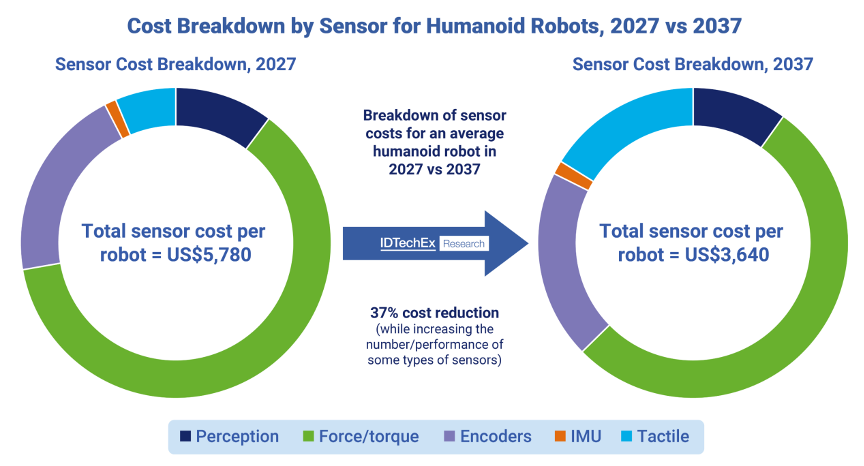
(IDTechEx: Sensors for Humanoid Robots 2027-2037: Technologies, Players, Forecasts)
This shift highlights a critical evolution: as robotic tasks expand from movement, transport, and path planning to delicate grasping, flexible assembly, safe collaboration, and complex environmental interaction, haptic sensors capable of directly perceiving contact states will play a significantly more vital role.
The increasing value of haptic sensing comes with higher performance demands from the industry.
In a laboratory environment, a haptic system can pass technical validation simply by detecting pressure, recognizing contact, or outputting clear data. However, in real-world settings such as factories, warehouses, commercial spaces, and homes, robots face continuous operation, repeated loading, bending impacts, temperature and humidity fluctuations, electromagnetic interference, and surfaces with varying materials and shapes.
Consequently, commercial clients no longer focus solely on sensitivity, detection range, or single-response speed. Instead, they prioritize whether a sensor maintains consistency over long-term use, operates reliably across complex curved surfaces and packaging structures, allows rapid calibration, offers anomaly diagnostics, and comes with a supplier capable of supporting continuous scaling and volume delivery.
This means competition in haptic sensing is extending beyond individual sensitive components to encompass flexible packaging, array design, acquisition circuits, signal processing, calibration algorithms, data interfaces, and large-scale manufacturing capabilities. Successfully validating a prototype does not mean a product is ready for commercial robotics; moving from the lab to volume production requires solving a series of engineering challenges around reliability, consistency, system integration, and supply chain readiness.
In response to this industry trend, ADW has strategically positioned its full-stack haptic sensing technologies, establishing an ecosystem that combines flexible haptic perception with intelligent hardware and software. This coverage spans core applications including dexterous hands, humanoid robots, companion robots, and bionic robots.
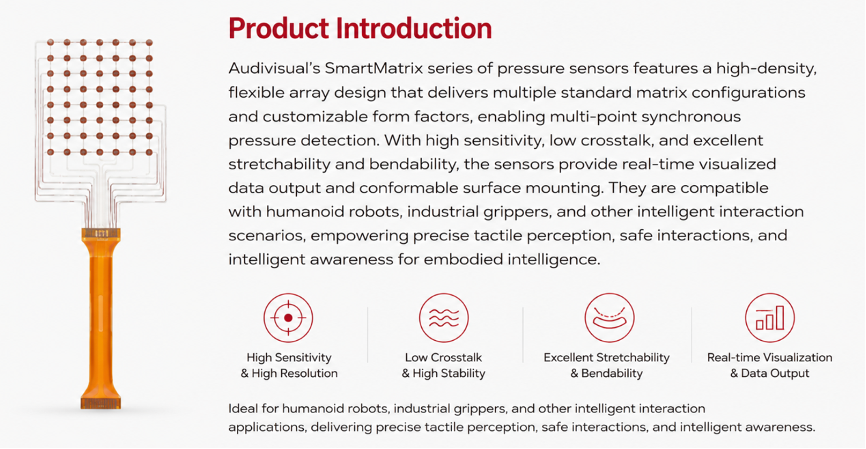
Leveraging flexible electronic skin and high-sensitivity haptic perception, ADW’s solutions achieve millisecond-level haptic response, precisely capturing subtle pressure changes and contact profiles. In practical deployment, ADW offers tailored solutions optimized for different parts of a robot:
· Fingertips and Palms: Focused on precise contact positioning, pressure distribution, and slip trend detection.
· Soles: Focused on dynamic center-of-pressure and terrain variation tracking.
· Torso and Limbs: Focused on collision detection and safe human-robot interaction.
Drawing on extensive expertise in piezoelectric materials, sensors, actuators, and mass manufacturing, ADW’s technology not only gathers precise contact data but also generates controllable haptic feedback via piezoelectric actuators. This creates a complete closed loop from "perception" to "feedback," enabling robots to deliver more natural and secure human-robot interactions in complex environments.
As humanoid robots enter the commercialization phase, the quantity and performance requirements for sensors will continue to increase, with haptic sensing taking on an even higher share of value within the overall perception framework. Future market competition will likely depend less on the single-spec performance of a specific sensing technology and more on whether a product can adapt to curved surfaces, withstand long-term repeated loading, thrive in real commercial environments, and deliver stable, calibratable, control-ready data.
Feel free to reach out to our Field Application Engineering (FAE) team for product datasheets, samples, and evaluation kits:
Technical Support & Sample Request Email: info@adwsensor.com.
 Come Back