


News

Driven by industry trends toward equipment miniaturization, intelligence, and high integration, traditional fluid control technologies face critical bottlenecks such as bulky dimensions, elevated operating noise, and severe electromagnetic interference (EMI). As a next-generation fluid control technology, the micro-jet air pump (piezoelectric air pump) leverages innovative structural design and actuation mechanisms to eliminate conventional motors and gear transmission components. This delivers a highly efficient, silent, and compact solution for precision fluid management.
I. Operating Principle & Core Technologies
1. Inverse Piezoelectric Actuation Mechanism
The primary driving force of the micro-jet air pump originates from the inverse piezoelectric effect of piezoelectric materials. When an AC electrical signal is applied, the piezoelectric ceramic undergoes micron-scale deformation under the electric field. This mechanism directly converts electrical energy into mechanical energy, generating high-frequency, low-amplitude vibrations in the ceramic resonator to drive fluid motion without requiring electromagnetic coils, rotors, or mechanical transmission assemblies.
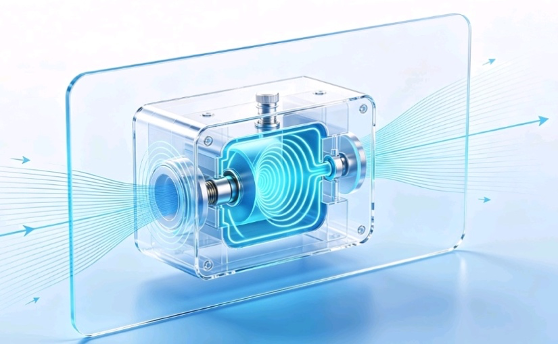
2. High-Frequency Cyclic Actuation and Fluid Control
Operating at a high frequency of 24.5 kHz (±2 kHz), the air pump continuously executes a "suction-exhaust" cycle. In coordination with internal micro-valves, these microscopic vibrations are transformed into a high-velocity, continuous airflow. The operating process comprises the following stages:
Exhaust Phase: The polarity of the driving voltage rapidly reverses, causing the piezoelectric actuator to flex downward and reset the membrane. The chamber volume contracts sharply, compressing the gas and rapidly raising internal pressure. This seals the inlet valve and forces open the outlet check valve, expelling the gas at high frequency.
3. Micron-Level Precision Control and Energy Efficiency
Because the deformation amplitude of piezoelectric ceramics is directly proportional to the applied peak-to-peak voltage (e.g., 25 Vpp square wave) and its vibration frequency synchronizes strictly with the electrical drive signal, the micro-jet air pump achieves exceptionally rapid response times. By precisely modulating the frequency and duty cycle (e.g., 50% duty cycle) of the drive signal, the system enables microliter-level (μL) flow regulation and stable pressure output. Furthermore, eliminating mechanical friction losses substantially enhances energy conversion efficiency, delivering consistent performance at ultra-low power consumption.
II. Comparative Analysis and Key Technological Advantages
Compared to conventional micro-diaphragm pumps (driven by motors and eccentric cams) and electromagnetic pumps (driven by electromagnetic coils and armatures), micro-jet air pumps offer generational technological advantages across physical form factor, actuation mechanisms, and electromagnetic compatibility:
High Reliability & Extended Service Life: The absence of mechanical friction parts eliminates lubrication requirements and wear-related failures. This design supports a operating lifespan exceeding 10 years. Coupled with minimal energy conversion losses, energy efficiency improves by over 40%, significantly extending the battery life of portable electronics.
Performance Comparison Matrix
Evaluation | Micro-Jet Air Pump (Piezoelectric) | Conventional Micro-Diaphragm Pump | Conventional Electromagnetic Pump |
Actuation Principle | Direct drive via inverse piezoelectric effect (high-frequency micro-vibration) | Motor + eccentric cam mechanical transmission | Electromagnetic coil + armature actuation |
Form Factor & | Ultra-compact (1/10th size of traditional pumps, low-profile design) | Complex structure, constrained by motor volume | Heavy and bulky due to iron cores and copper coils |
Operating Noise | Ultra-silent (<30 dB to ≤40 dB, virtually imperceptible) | Pronounced mechanical friction and low-frequency vibration noise | Armature impact noise and electromagnetic hum |
Electromagnetic | Zero EMI radiation; no magnetic interference | Motor brushes and coils generate notable EMI | Strong EMI radiation, prone to disturbing nearby sensitive circuits |
Control Precision | Supports μL-level flow precision and millisecond response | Slower response limited by mechanical inertia and backlash | High flow pulsation; lower stability and precision |
Energy Efficiency & Lifespan | High energy efficiency (+40% improvement), long lifespan (10+ years) | Cam and bearings prone to wear; limited lifespan | High coil heat dissipation; substantial energy loss |
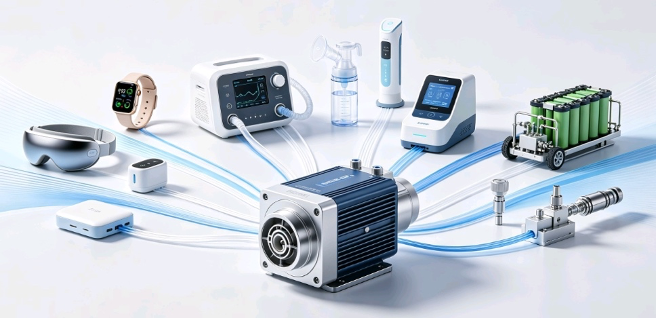
III. Market Trends and Key Application Scenarios
With the rapid adoption of smart wearables, home healthcare devices, and advanced consumer electronics, market demand for miniaturized, low-power, and silent fluid control components continues to escalate. Micro-jet air pumps are rapidly penetrating three core sectors:
Applied in EV battery thermal management, high-pressure fuel injection, and sensor gas sampling, ensuring system safety and operational efficiency through precise thermal and pneumatic regulation.
Conclusion
By leveraging the inverse piezoelectric effect, the micro-jet air pump redefines the technological pathway of traditional mechanical pumps, establishing new benchmarks in miniaturization, energy efficiency, acoustic performance, and precision control. As the markets for smart healthcare and wearable devices continue to expand, this technology is poised to become a vital driver in advancing micro-fluidic control systems.
 Come Back