


News

As smart terminals evolve toward intelligent interaction that responds to user intent, traditional smart switches are evolving from simple "motion triggering" to "continuous distance and static target sensing."
Conventional solutions have inherent limitations: PIR can miss stationary users, causing unintended lights-off; capacitivetouch performance depends on enclosure thickness and material and can be affected by moisture and oil; radar requires RF integration, while optical ToF requires a suitable optical window and consideration of ambient light and target reflectivity.
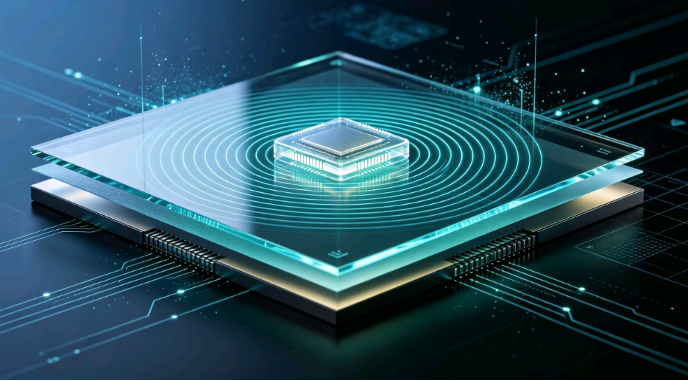
PMUT (Piezoelectric Micromachined Ultrasonic Transducer) leverages semiconductor MEMS processes to deliver active ultrasonic Time-of-Flight (ToF) distance sensing. It offers a balance between footprint, cost, non-imaging detection, and static target sensing. Coupled with a "software-defined" architecture, a single hardware platform can be configured for custom trigger thresholds and false-trigger suppression logic, providing a cost-effective, reliable sensing switch for wearables, smart homes, and embodied AI.
1. Core Technical Advantages of PMUT Smart Switches
- Active Acoustic ToF & Static Target Sensing: PMUT emits ultrasonic pulses and measures two-way acoustic Time-of-Flight (ToF) to calculate physical distance. As long as a target generates stable echoes within the operating range and field of view, PMUT can continuously output distance even when the target is stationary, addressing a key limitation of PIR. It captures no images and does not rely on ambient light, enabling sensing in darkness or bright sunlight.
- Scalable MEMS Process for Cost-Effective Integration: Unlike conventional bulk piezoelectric ceramics, PMUT utilizes MEMS manufacturing. Wafer-level production supports compact dimensions and high uniformity, enabling cost-effective sensing and system integration.
- Software-Defined Flexible Interaction: PMUT combines physical sensing with software-configurable control algorithms. Via firmware, developers can define multiple distance-based interaction zones (e.g., proximity wake-up and hover confirmation) and false-trigger suppression logic without changing hardware.
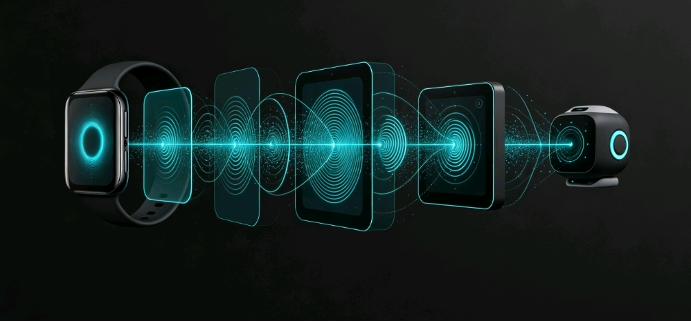
In smartwatches, TWS earbuds, and AR glasses, mechanical buttons occupy valuable space and add sealing requirements, while touchscreens struggle with wet or gloved hands. Within its validated near-range operating limits, PMUT establishes an active sensing zone: "approaching" wakes the screen, "hovering" confirms, and "leaving" cancels. By tracking continuous distance changes, it supports gesture discrimination through application-specific control logic.
In smart home and security applications, PMUT can be installed discreetly within an enclosure, with micro-apertures providing an unobstructed acoustic path; it cannot sense through solid glass, wood, or stone panels. It can support approach-based lighting and detection of stationary targets within the sensing zone. Touchless control does not require direct finger contact, but aperture geometry, sealing, and contamination must be considered during integration. For smoke detector obstruction self-inspection, PMUT can establish an acoustic baseline around smoke detector entry vents. When tape or debris obstructs the vent, echo changes can indicate a need for maintenance, adding an online self-inspection capability. Detection of different obstruction types requires validation; this function supplements existing diagnostics rather than replacing smoke detection.
Primary perception sensors (cameras and LiDAR) can leave blind spots near robotic joints and grippers. Distributed PMUT modules across a robot's body can form a "Proximity Early Warning Network," providing local proximity data to support alerts, speed reduction, and trajectory adjustments by the robot control system. Any emergency-stop function requires separate system-level safety design and validation.
3. Technology Comparison Overview
- PMUT Ultrasonic ToF: Detects stationary targets with valid echoes; independent of ambient light; non-imaging; compact and cost-effective via MEMS. Boundaries: Requires an unobstructed acoustic path; influenced by target geometry, acoustic reflectivity, ambient temperature, and near-range limits.
- Passive Infrared (PIR): Weak static presence detection; low cost and minimal standby power. Boundaries: High risk of missing stationary users; sensitive to thermal fluctuations.
- Capacitive Sensing: Detects touch and proximity; can be concealed behind suitable non-metallic panels.Boundaries: Range depends on electrode design and enclosure properties; sensitive to moisture, oil, and grounding.
- Microwave Doppler: Sensitive to motion; can be concealed behind suitable RF-transparent enclosures.Boundaries: Weak static detection; conventional Doppler-only implementations do not directly measure absolute distance; potential out-of-zone false triggers.
- Millimeter-Wave FMCW Radar: Supports ranging and presence detection using motion and micro-motion information. Boundaries: RF complexity, power draw, and BOM cost depend on the selected device and processing requirements.
- Optical ToF: Accurate distance output without imaging; fast response times. Boundaries: Requires a suitable optical window; performance depends on ambient light, target reflectivity, and cover-window integration.
Switches are evolving from passive input hardware into intelligent sensing nodes that respond to user intent. Leveragingactive acoustic ToF, concealed installation with micro-apertures, and independence from ambient light, combined withcost-effective MEMS manufacturing and software-defined flexibility, PMUT provides a highly competitive sensing interface for next-generation hardware.
Evaluating touchless control or proximity sensing for your next product? Email info@adwsensor.com with your application, target object, required sensing range and response time, and enclosure constraints, including available space and micro-aperture requirements. Please include your company, contact details, and project stage so we can discuss PMUT suitability, integration requirements, and sample evaluation options. Suggested email subject: PMUT Application Evaluation.
 Come Back